Deliverables
What you receive, in writing.
Each stage of the work closes with a document. Seven exist today, and the pages shown below are those templates rather than descriptions of them.
They are shown unfilled, because they are filled during an engagement.
Before the engagement
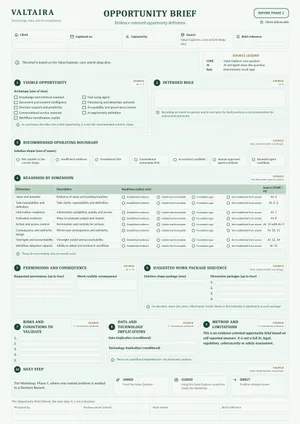
Opportunity Brief
Evidence-oriented opportunity definition
Produced by Value Explorer™ before any engagement begins. Sets out the visible opportunity, the intended role for a solution, a recommended operating boundary, readiness by dimension, and the risks and conditions still to validate.
Phase 1, understand and decide
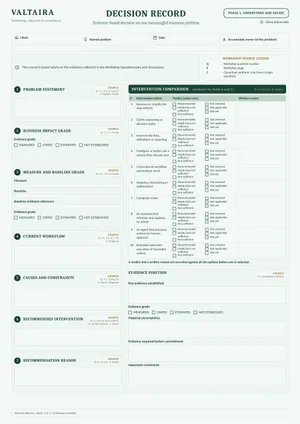
Decision Record
Evidence-based decision on one meaningful business problem
Twelve fields covering the problem, the current workflow, the causes and constraints, the recommended intervention and the reason for it, the evidence position, and the decision gate that closes the phase. It carries the Intervention Comparison, where a verdict and a written reason are recorded against all ten options before one is selected.
Phase 2, prepare and design
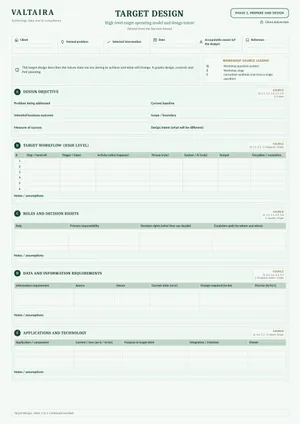
Target Design
High-level target operating model and design intent
The target workflow, roles and decision rights, data and information requirements, applications and technology, exceptions and escalation, and the design decisions still open.
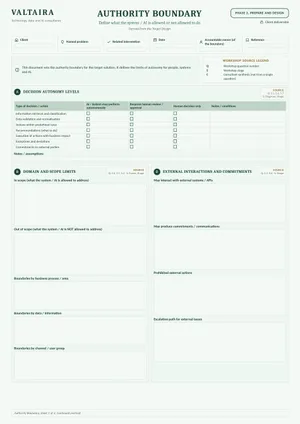
Authority Boundary
What the system or AI is allowed and not allowed to do
Decision autonomy levels, domain and scope limits, data use limits, external interactions and commitments, accountability and ownership, and how an out of boundary event is handled.
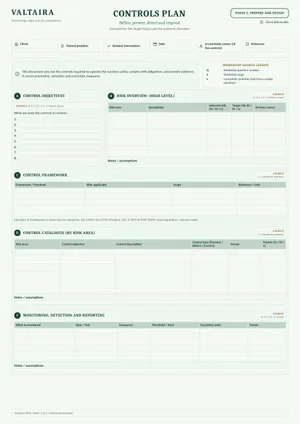
Controls Plan
Define, prevent, detect and respond
Control objectives, a risk overview, the control catalogue by risk area, monitoring and detection, incident response and recovery, and assurance and review.
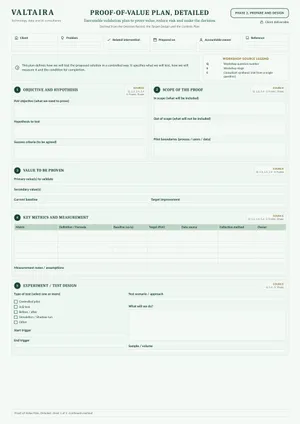
Proof-of-Value Plan
Executable validation plan to prove value, reduce risk and make the decision
The hypothesis and scope, the value to be proven, the metrics and how they are measured, the test design, roles, risks and mitigations, and the success criteria and decision gate.
Phase 3, deliver and improve
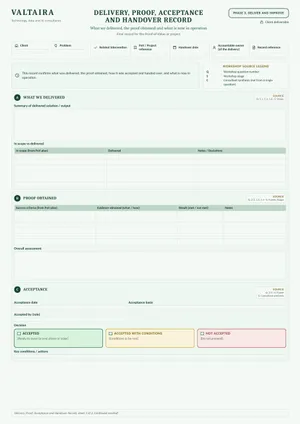
Delivery, Proof, Acceptance and Handover Record
What we delivered, the proof obtained and what is now in operation
What was delivered, the proof obtained, formal acceptance, operational handover, the running and support model, the post-implementation baseline, and the benefits evidence.
One at readable size.
The Decision Record closes Phase 1. This is its first sheet, unfilled. The Intervention Comparison sits in the right hand column, where a verdict and a written reason are recorded against all ten options before one is selected.
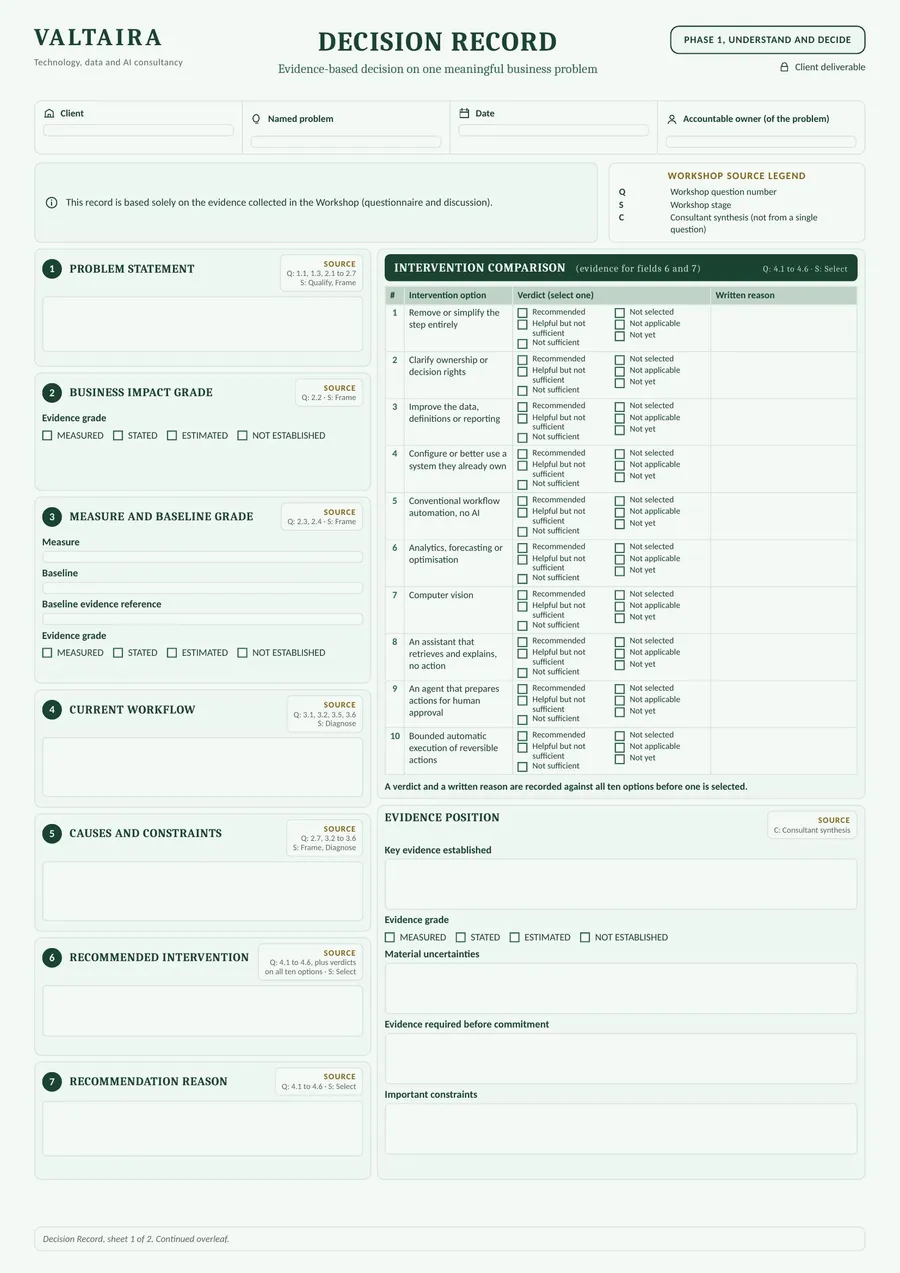
The comparison is released, not summarised.
Every one of the ten options carries a verdict and a written reason, including the routes that were not selected. The client keeps that page and can use it to challenge the recommendation or to brief another supplier.